Signed in as:
filler@godaddy.com
Signed in as:
filler@godaddy.com
Get professional skate sharpening when you need it. Schedule your next sharpening now.
Choose a one‑time sharpening or subscribe for monthly service:
Subscriptions apply to one pair of skates and renew automatically. Cancel anytime by emailing chris.barone@enchl.com
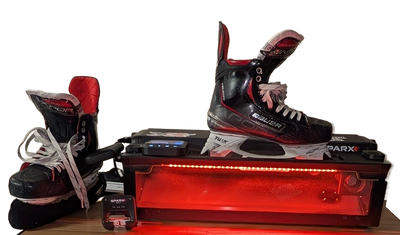
A traditional skate hollow uses a rounded groove, which creates two edges and a curved bottom. The depth of that curve controls how much bite you get — deeper hollows give more grip but also create more drag, which reduces glide.
A flat‑bottom hollow reshapes that groove into a flatter center with two sharp edges. Because the middle is flatter, there’s less surface area contacting the ice, which reduces friction. The result is a sharpening that delivers more glide while maintaining the same level of bite/grip you’d expect from a traditional hollow of similar depth.
Skater weight and ice conditions both play a big role in choosing the right hollow. Heavier skaters naturally press deeper into the ice, which increases bite, so they often prefer a shallower hollow to avoid feeling too “stuck” or over‑gripped. Lighter skaters don’t sink in as much, so they typically benefit from a deeper hollow to get enough edge control.
Ice conditions matter just as much. Harder, colder ice provides less natural bite, so a slightly deeper hollow helps maintain grip. Softer, warmer ice creates more friction, so a shallower hollow keeps the skates from digging in too aggressively.
Finding the right hollow is all about balancing weight, ice hardness, and the feel the skater wants on their edges.
Copyright © 2026 ENCHL - All Rights Reserved.
We use cookies to analyze website traffic and optimize your website experience. By accepting our use of cookies, your data will be aggregated with all other user data.